Why Time Moves Forward
We can turn around in space, but time offers no equivalent route back. Yet a memory from twenty years ago can feel recent. Why does time move forward while memories sometimes feel so close? What interests me is the difference between distance on a calendar and distance in the mind.
Contents
Returning to a place is not returning to a moment
We can walk down a street twice or replay a film. At the same intersection, the location may remain, but the person arriving and the moment of arrival have changed. What we call “going back” is often only a return in space.
Saying that time and space are relative does not make them identical. In special relativity, an event can be represented by four coordinates:
\[ (ct,x,y,z) \]
Here c is the speed of light in vacuum. Multiplying time by c gives all four coordinates units of length. Equal units do not imply equal geometry. If time were an ordinary fourth spatial direction, we would expect a Euclidean squared distance with four positive terms:
\[ d\ell_E^2=c^2dt^2+dx^2+dy^2+dz^2 \]
In flat spacetime, with the negative-time, positive-space convention, the interval is instead:
\[ ds^2=-c^2dt^2+dx^2+dy^2+dz^2 \]
The overall signs can be reversed; what matters is the relative sign difference. Unifying space and time does not erase this distinction. Turning around in space cannot simply become turning around in time.
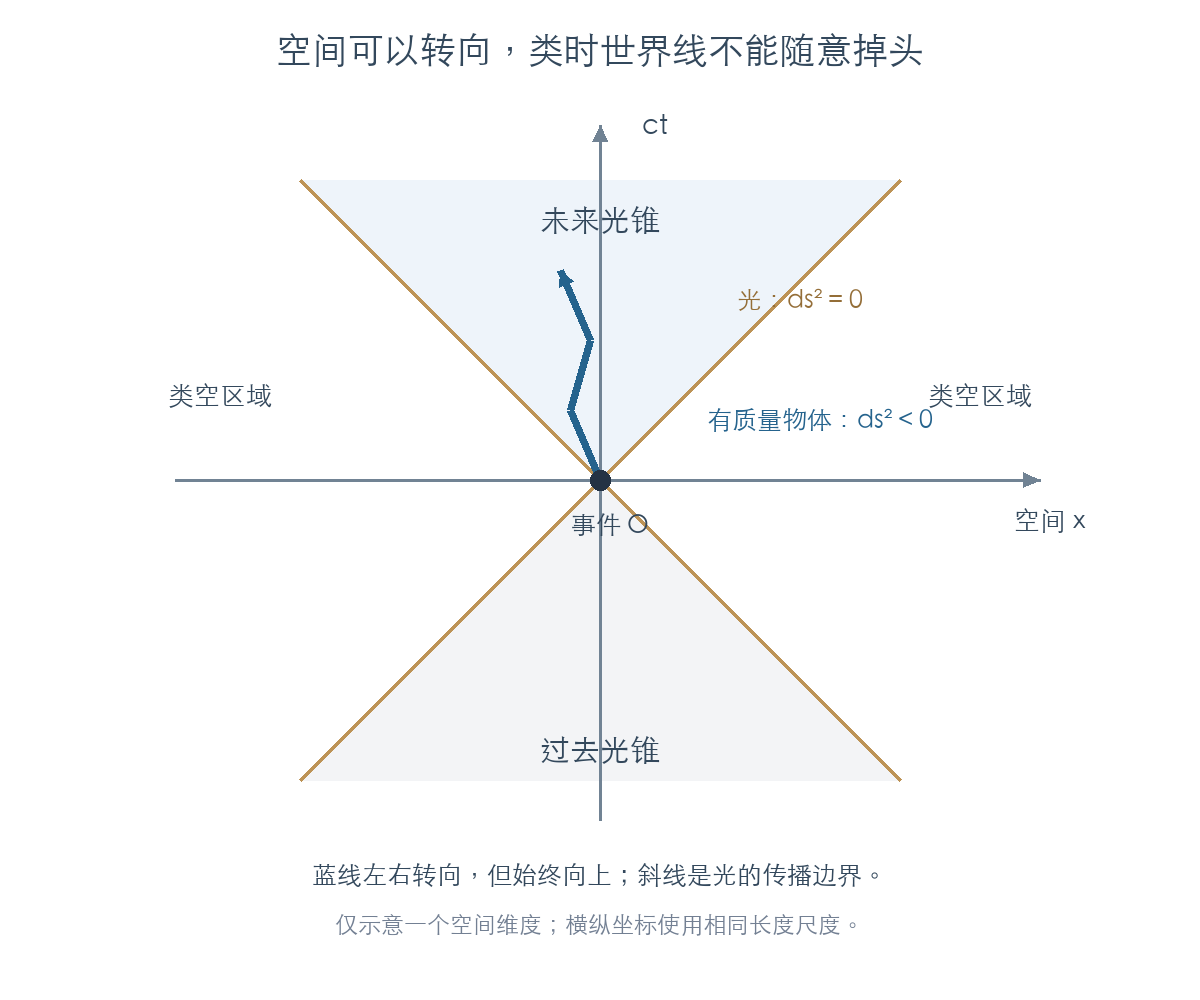
A light cone makes the distinction clearer. With just one spatial direction, light follows its boundary:
\[ ds^2=0\quad\Longrightarrow\quad dx=\pm c\,dt \]
Massive objects follow timelike worldlines. Under this sign convention:
\[ ds^2<0,\qquad d\tau^2=-ds^2/c^2=dt^2-(dx^2+dy^2+dz^2)/c^2 \]
Proper time τ is measured by a clock carried along the worldline. Events in the past light cone can affect the present event, which can affect events in its future light cone. Einstein Online’s spacetime introduction explains this causal structure.
In special relativity, a smooth, everywhere-timelike worldline cannot continuously switch from the chosen future direction to the past while remaining timelike. Spatial velocity can reverse, but temporal orientation does not reverse in the same way. This geometric restriction still leaves another question: why do everyday changes consistently point one way?
Entropy explains irreversibility, not the meaning of life
Geometry is not the whole story. An idealized billiard-ball collision can be written schematically as:
\[ A+B\longrightarrow C+D \]
In an ideal classical model, reversing the motion and all velocities can still satisfy the equations. Many microscopic laws have related time-reversal properties. But not every fundamental law is completely time-symmetric: weak interactions exhibit T-symmetry violation. The pronounced macroscopic arrow cannot be explained simply by saying the equations prohibit playing the movie backward.
For macroscopic processes in an isolated system, the second law gives:
\[ \Delta S_{\mathrm{isolated}}\geq0 \]
S is entropy. Irreversible processes increase it, with equality for an ideal reversible process. Statistically, this is an overwhelmingly strong macroscopic tendency, not a claim that a finite system can never have an entropy-decreasing fluctuation.
Hot coffee cools; dispersed perfume does not spontaneously gather back into its bottle. Statistical physics relates such directionality to entropy: higher-entropy macrostates correspond to more microscopic possibilities. Combined with a special low-entropy past, this helps explain why many processes share an arrow. Sean Carroll’s time-arrow FAQ carries the question back to cosmic initial conditions.
\[ \text{low entropy}\longrightarrow\text{high entropy} \]
A reverse evolution is not logically contradictory just because we draw that arrow. Macroscopic restoration would require extraordinarily special microscopic conditions. And counting more high-entropy possibilities is not sufficient on its own: time-symmetric dynamics do not select which end is the past. We also need an account of the special low-entropy past.
The early universe was hot and nearly uniform, yet special and low-entropy when gravitational degrees of freedom are considered. Why those boundary conditions existed remains a deeper cosmological question. The low-entropy past is a clue rather than a final answer.
I do not want to paste “entropy increase” onto every regret. It describes statistical properties of physical states, not the worth of a day. Tidying a room, learning a skill, or repairing a relationship does not violate the second law. Local order can form while heat is released to the surroundings; local change alone cannot determine total entropy change.
Nor does decreasing local entropy make a clock run backward. A freezer can turn water into ice, but freezing still happens at a later moment. Separating local change, worldline orientation, and the felt passage of time clarifies the question.
The personal lesson is modest: irreversibility does not mean everything must deteriorate. What happened cannot be undone, but something new can still be done. Accepting a limit and abandoning action are different choices.
Why can distant memories feel close?
A familiar voice or an unexpected sentence can bring back an old feeling. The calendar distance remains, while the felt distance changes.
Numbers record elapsed years; recollection gives certain moments weight again. Old events can be vivid while recent days blur. Experienced distance does not always follow chronological order.
Remembering does not send consciousness into the past. Photographs, words, and traces in the brain exist now, and help us understand what happened. That interpretation is itself a present experience. A familiar image does not guarantee accurate details, although it may carry real emotion.
Feeling that an event is not distant need not mean time actually shrank. Some things continue to participate in present life: stories we loved, days that shaped habits, and people and events we revisit in thought.
A four-dimensional map does not decide how to live today
Imagining a life as a worldline can bring a curious calm: each stage has its place. But moving from a mathematical spacetime description to the claim that past and future exist in the same way involves philosophical interpretation. The block universe should not be presented as the only worldview relativity has proved.
An interrogative expression in the original discussion points to the difficulty of explaining a moving present:
\[ \frac{d(\text{now})}{dt}=1\;? \]
This is not a physical law. “Now” has not been defined as a differentiable physical quantity. Defining it as coordinate time t would yield an identity, not an explanation of felt passage. Relativity describes clocks, events, and causality; the expression does not answer why consciousness experiences an updating present.
I also resist inferring that effort is pointless because the future is already written. Describing spacetime is not the same question as how a person acquires information, chooses, and bears consequences. A discussion of time cannot directly settle everyday action.
The site’s Long Couplet of Kunming’s Daguan Tower (Chinese) offers another approach: consider a longer timescale, then return to the present. Physics draws attention to boundaries; writing conveys weight. Neither must prove the other.
If a map contained every moment of a life, the available work would still be present work: understand a problem, express something clearly, and record what deserves to remain.
Writing is one way to respond
“Cherish the present” is easy to say and needs concrete action. Writing down these questions is one such response. It does not stop today or guarantee a future interpretation, but gives a later look back something to work with.
Records can remind us that the past was not only vague happiness and the present is not only busyness. Writing preserves unanswered questions and reveals how thinking changes.
Deep questions remain about time’s direction, the universe’s low-entropy past, and the feeling of a moving present. I do not want to fill those gaps hastily with life lessons. Knowing where an explanation ends makes the reflection firmer.
I cannot travel back along time, but can respond anew to what the past left behind. In twenty years, today will also be inaccessible. I hope a look back will find traces of things carefully considered and done.
Further reading
- Einstein Online: Spacetime, educational material from the Max Planck Institute for Gravitational Physics on spacetime and light-cone causality.
- Sean Carroll: From Eternity to Here — FAQ, a discussion of entropy, the arrow of time, and low-entropy initial conditions. These sources support the physics background; personal meaning and value judgments belong to this reflection.
English edition added on October 7, 2026, after the Chinese edition. The article date matches the Chinese edition; it is not the actual time this English edition became public.
Support
If this article helped you, you can support this site.



Click a QR code to enlarge. More options: support page。